It is best that inherited property is divided “equally” among the heirs!
There are many who think this way.
In this article, I would like to explain about the potential loopholes and trouble accompanying the equal dividing of the inherited real estate.
――――――――――――――――――――――――――――――――
The more eligible heirs there are, the more difficult becomes the dividing up of the property after one’s parent or relative has passed away.
This is because that it is necessary for all eligible heirs to gather all at once to conduct a discussion pertaining the property division.
Assuming that the property under contention is a piece of land and a house build upon it. In this case, we would all be puzzled as how this could be divided up.
Many think that it is best for the property to be divided evenly among everyone. But is that really the best choice?
All heirs own the inherited real estate
Owning a real estate by more than one person is equivalent to ownership under a “shared name”It may seem like up a peaceful solution, but actually, it could lead to much trouble later on.
What happens under a shared name?
1. The house cannot be sold without the agreement of all heirs.
Let’s assume that under the joint inheritance, one of the holders start to think,
“I want to sell the inherited house”.
However, in order to sell the entire house, consent from each and every one of the other stake holders must be acquired.
The house could not be sold off if even one of the co-owners express disagreements.
One could possibly sell off only the section that he or she owns, however only a single section of a house would not be highly evaluated from real estate agents.
Because it will be difficult for ordinary people to buy it, it could possibly be bought at a very low price by the real estate agent.
2. If the majority of the co-owners disagree, the property cannot even be managed
Did you know the rule that “the management of the inherited real estate requires the agreement from more than half of the heirs.”?
Even if one of the co-owners wants to repair the house, he would need to get permission from more than half of the other joint holders.
The same applies when one wants to rent out the house, such as when no one is living in it at the present.。
3 Must continue to pay property tax
One must pay property tax while owning real estate every year.
It doesn’t feel reasonable to have to pay property tax for a real estate which you cannot manage freely.
There are still more disadvantages of shared name inheritance!

More and more co-owners
When one of the co-owners passes away, that person’s property will be inherited by multiple pf other people, thus the number of co-owners will increase.
As the years pass, there would be so many co-owners that it would be hard to keep track of everyone.
From my point of view, the worst scenario is when a total stranger (to you) suddenly appears and takes hold of someone’s stake.
Not likely to be able to use as collateral
Many financial institutions do not allow co-owned real estate to be used as collateral when borrowing a loan.
(* There are some exceptions)
This is also an important point.
The joint holder would be decided out of your reach.
If you receive a loan with your co-ownership as collateral and it goes bad,
The stake would fall into the hands of a total stranger (third party person).
Due to the disadvantages mentioned above,
As an inheritance expert, I can’t recommend joint ownership of real estate.
Please take the next generation in to consideration when inheriting real estate.
Please conduct a thorough simulation!
Since this is an important matter, we recommend that you consult an expert ahead of hand.
How to deal with heirs who cannot be contacted (family registration)
Here are some ways that may be helpful in making contact with the missing heir:
・Trace the family registration to find out the permanent address
・Obtain a family registration tag
Family registration documents can be a powerful clue when searching for missing heirs , thus please check with the city hall first.
How to deal with heirs who cannot be contacted (legal procedures)
After you have tried all you can think of and still cannot reach the missing heir, it might be a good idea to appoint an “absentee property manager”, whose job is to manage and keep the property on behalf of the heir who cannot be contacted.
If the “permission for acts outside the authority” can be obtained from the domestic affairs court, the appointed personnel can also participate in the discussion of the division of inheritance.
In most cases, relatives who receive no effect from inheritance are selected as absentee property administrators. In the case where there are no candidates, the domestic affairs court will appoint an attorney.
If a person has been missing for 7 years or more and his or her life or death is unknown, one can choose to make a “declaration of disappearance”. When a person is officially declared “missing”, by records, it is equivalent to being considered dead.
In inheritance division negotiations, the procedures will be carried out assuming that heir has passed away.
A declaration of disappearance can be filed with the domestic affairs court to which the missing heir’s residence belongs to. Because investigations must be carried out, it could take more than half a year until the decision is finalized. In this case, this strategy may not allow one to meet the deadline for filing inheritance tax, so please use it as a last resort.
Measures to prevent dispute among heirs over inheritance division issues
Measures to prevent dispute among heirs over inheritance division issues
Gift during lifetime
This points to a gift of property to others while you are still alive.
Because you can transfer your property to descendants before you pass away, the
recipient gains the benefit of being able to use that property for living, education, and other expenses.
Inheritance tax is imposed when a relative dies and property is inherited through inheritance procedures, while inheritance tax is not levied on property gifted during life.
However, if the gift is given to a relative (legal heir) who has the legal right to inherit property, the methods described above may not be valid in some situations.
Exactly what situations?
One situation is when a relative dies within 3 years from the lifetime gift and an inheritance occurs following that.
In other words, it is important to note that lifetime gifts made within 3 years from the start of inheritance are subject to inheritance tax.
Also, even when the gift is not made to a legal heir, for instance to a grandchild, and assuming that the person passes away three years after the gift is given, and the grandchild receives the death insurance money from your death, the inheritance tax will be applied to the property that you had given before your passing.
It is said that giving gifts in lifetime serves to spare the heir of inheritance tax, but as mentioned above, there is still possibility that the system of inheritance tax will change in the future.
It is recommended to consult a tax advisor before taking actions.
Making an official will
A notarized will is made in a notary public’s office in the presence of two witnesses.
As it is verbally declared by the testator, it is deemed to be more reliable than a will made by a notary public.
The existence and contents of the will are stated clearly, and probate by the domestics affairs court is not required.
The original will is kept at the notary public office (in principle for 20 years), thus alleviating one of worry of falsification or loss.
Summary
All heirs must agree on the division of the inheritance. Even relatives who have not been contacted for a long time and cannot be reached for whatever reason, cannot be ignored as long as they possess inheritance rights. Proceeding with the inheritance division negotiations without all eligible heirs present will only invalidate and delay the inheritance procedure.
Therefore, if there is an heir who cannot be contacted, please resolve the problem in a legal and appropriate way.
“cannot be contacted” does not mean “abandon of inheritance”
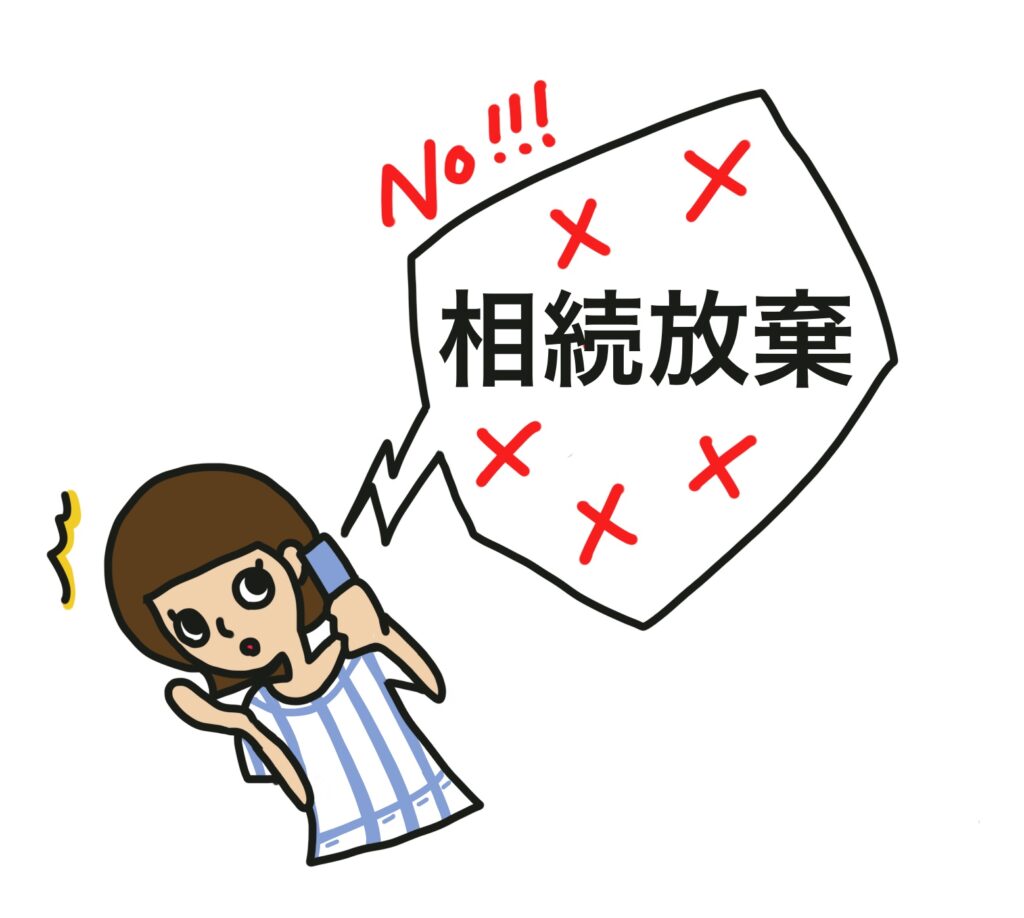
There are some who misunderstand “you cannot be contacted = you abandoned the inheritance”
This is a big mistake.
In order to renounce inheritance, procedures must be carried out in the domestic affairs court.
There are some cases in which due to poor relationship between the heir and the relatives of the deceased, the heir chooses to ignore the contact from the relatives simply to avoid becoming involved.
For example, if the deceased carried debts, no matter how much you ignore the contact, it will not be considered as “renunciation of inheritance”, and you would still inherit the debts.
In any case, when you are contacted regarding inheritance, please complete the necessary procedures as soon as possible.
It is possible to discuss the division of inheritance even if not all designated heirs are present. However, in this case, the content of the discussion is legally invalid. Once again, let’s remember that “cannot be contacted” does not mean “abandon of inheritance”! !
The procedures are being delayed due to the absence of some of the heirs…!
As afore mentioned, when there is a deadline to the inheritance procedures, there are many demerits caused by not being able to get in touch with some of the heirs.
For example, the deadline for renouncing inheritance.
When the deceased carries debt, one can avoid that debt by renouncing inheritance.
However, this can only be carried out within 3 months of knowledge of the commencement of the inheritance. This is the deadline for the procedure.
Some other examples are the declaration and payment of inheritance tax. This can only be carried out within 10 days of knowledge of the commencement of the inheritance.
Do you know what happens if you don’t report by the deadline?
Additional tax due to non-declaration violation may be imposed.
What kind of people cannot be contacted?
Next, let’s go over what kind of people cannot be contacted.
I shall introduce some representative cases.
・relatives with whom one has a poor relationship or has not had contact over a long period
・siblings who have moved without transferring their resident card
・siblings who is not known to be alive or not, and their offspring (representative heir)
・the children of the ex-wife (divorced)
・children born out of infidelity
If any of the above applies to your case, please take measures as soon as possible to deal with the issue.
【NEXT】 What should one do when some of the heirs cannot be contacted?③
~連絡がとれない相続人への対処法~

How will it affect the inheritance procedures?
When one’s parents pass away, inheritance procedures are something that cannot be avoided.
In most cases, all eligible heirs must come to an agreement on how to divide up the property
to be inherited.
The deceased should have left behind a formal will of some kind. Or alternatively,
if all heirs are willing to communicate, the dividing of the inheritance should proceed smoothly.
However, there are certain cases where a part of the heirs cannot be reached,
and due to the lack of contact the inheritance procedure is hindered.
The inheritance process has a few stages, and each stage comes with a deadline.
Because the inheritance procedures are carried out while confirming the intentions of all heirs,
if some of them cannot be contacted, the entire procedure would become significantly
delayed.
An inheritance division negotiation is where heirs gather to discuss and agree upon how to
divide the inheritance left by the deceased.
In this situation, it is not allowed to leave out one or more of the heirs and proceed with the
inheritance division discussion, simply because one has trouble making contact with them.
In inheritance division negotiations, if there is a formal will, it basically takes precedence.
However, there are exceptions, such as when the contents of the will are in the following
conditions.
・Only a part of the inheritance is specified in the will
・One or more of the heirs are not satisfied with the contents of the will.
In this case, all heirs must discuss how to carry out the division in detail, after which all must agree to the division of the inheritance.
Recently more and more people are drawing up a will in order to avoid disputes after they are gone.
However, if even one of the heirs is dissatisfied with the contents of the will, it would obstruct
the negotiations.
The reality of inheritance is that, even if you have prepared a will, it does not guarantee that
everything will fit together smoothly.
That is the reality of inheritance.
Here, “all heirs” includes heirs who cannot be contacted.
In other words, if the inheritance procedures had been carried out while ignore the heirs who cannot be contacted, the agreement surrounding that inheritance would be deemed invalid.
Even if only a part of the heirs reaches an agreement, when the heir who could not be
contacted later appears and claims his or her right, all procedures must be done over from the
beginning.
There is no deadline for an inheritance division consultation, so nothing can formally stop it
from being redone as many times as needed.
Needless to say, protraction of inheritance negotiations would just increase and prolong the
burden on all heirs.
Once the contents of the inheritance division have been settled through the negotiations, it is
necessary to prepare the inheritance division document which records the contents agreed
upon. Here also, the signatures and seals of all heirs are required, and it is not possible to
exclude those who cannot be contacted.
Without this officially documented agreement, it is not possible to change the name of the
property of the deceased, nor ‘ manage the deposits and savings.
One can say without exaggeration that this inheritance division agreement document is the
cornerstone of the inheritance procedure.
It is strongly recommended to avoid letting thus agreement become invalidated
【NEXT】 What should one do when some of the heirs cannot be contacted? ②
お問い合わせ